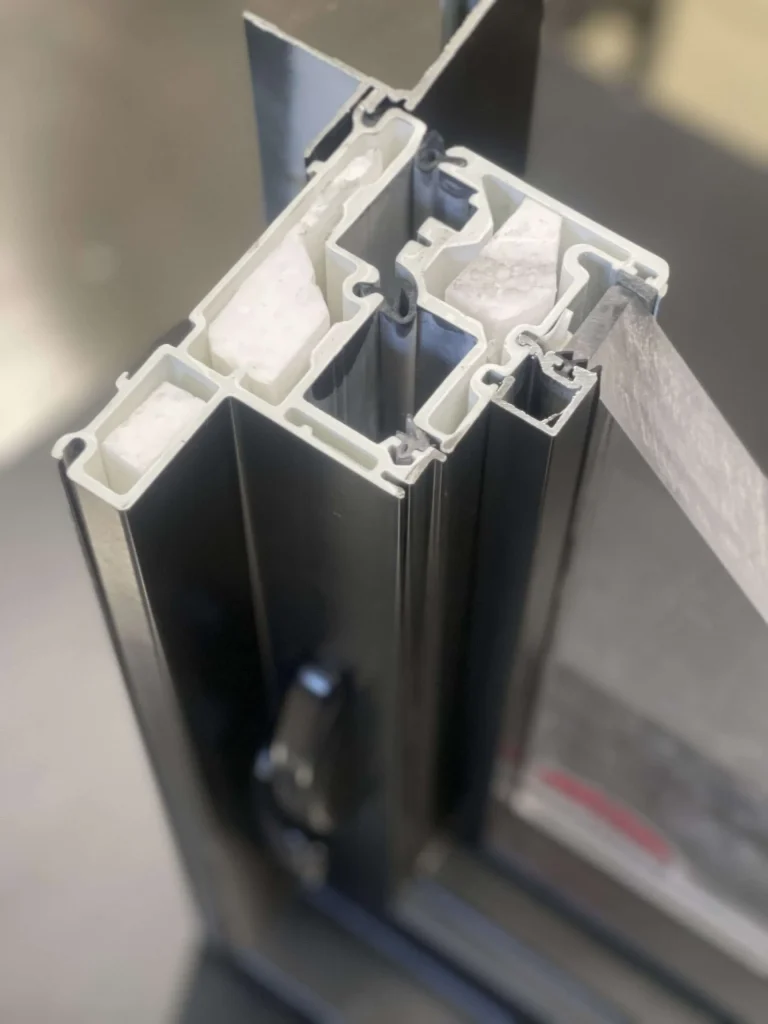
The benefits of fiberglass, essentially a carbon fiber product, finds utility in various applications such as boats, satellites, bridges, and goalie masks. In these applications, it is exposed to extreme temperatures and constant wear. This durability and resilience make fiberglass windows and doors the optimal choice for those who prioritize durability, energy efficiency, and design flexibility.
Energy-efficient frames with low conductivity discourage the transfer of heat or cold into a building. Compared to metal options, fiberglass windows exhibit significantly lower conductivity. This contrast becomes apparent when comparing the feeling of a fiberglass window frame to that of an aluminum frame in -20°C weather.
In temperature extremes, fiberglass windows must maintain stability, minimizing expansion and contraction to ensure an effective seal. Considering that the bulk of a window consists of glass, surrounding it with a material like fiberglass offers numerous advantages, hence the “Glass on Glass Advantage.” Comprising approximately 60% glass, fiberglass, like plate glass, demonstrates a very low rate of expansion and contraction. This characteristic allows fiberglass windows to maintain an excellent seal with reduced movement compared to plate glass.
Furthermore, superior stability translates to increased longevity, fewer seal failures, and enhanced paint adhesion.
With an impressive 60% glass content, fiberglass stands out as a top-tier material, primarily derived from abundant silica sand – a true testament to sustainability! Its production demands only a fraction of the energy required for aluminum, making it an eco-friendly choice.
But that’s not all! Fiberglass durability translates into a minimal environmental footprint, offering a solution to our throwaway culture. Investing in enduring products like fiberglass not only curbs landfill waste but also aligns with DUXTON’s commitment to sustainable construction practices that endure for generations.
And here’s the clincher: fiberglass’s exceptional energy efficiency and material qualities make it a popular pick for cutting-edge projects like Net Zero, LEED, and PassivHaus initiatives. It’s the smart, sustainable choice for a brighter future!
The benefits of fiberglass are endless, but one of the most notable is that fiberglass windows and doors boast impressive bend strength, significantly surpassing PVC. This enhanced strength allows for slimmer frames and larger glass areas, creating stunning views with fewer frame divisions. With fiberglass windows, you can achieve panoramic views with floor-to-ceiling glass that spans the entire length of your room, inviting the outdoors into your indoor space.
The most significant difference between fiberglass and PVC is the rate of expansion and contraction, which affects the longevity of both the frames and the glass, as well as the smooth operation of the windows over many years. Fiberglass windows offer superior energy efficiency compared to PVC windows due to their excellent thermal insulation and tighter seals, which minimize heat transfer and air leakage, resulting in improved overall energy performance for your home.
PVC, unlike fiberglass, can become brittle and crack over time, especially when exposed to UV light. Additionally, there is a growing trend to remove PVC from homes due to health and environmental concerns. The “Living Building Challenge” prohibits PVC in certified products because vinyl chloride, found in PVC, is on their Red List of harmful substances. Duxton offers Declare certified products upon request (https://living-future.org/red-list/), adhering to these environmentally conscious standards.
For more details, visit Duxton’s website and learn about the benefits of better seals and durability.
Fiberglass windows and doors elevate your design possibilities with unparalleled color flexibility. While PVC typically limits you to light finishes or exterior colors only, fiberglass opens the door to endless color options both inside and out. Whether you prefer a classic hue or a custom shade, the stability of fiberglass allows you to choose any color, light or dark, without compromising durability.
Fiberglass stands out as an exceptionally stable material, boasting a lifespan projected to be about 40% longer than that of PVC windows. Its low-maintenance finish, applied akin to painting a vehicle, ensures a weather-resistant and enduring surface.
This remarkable material has found its place in a diverse array of commercial projects, from recreational centers and financial institutions to multi-storey towers. Its durability has been put to the test in schools located in the far north, where windows endure both harsh treatment and extreme temperatures.
Crafted from a blend of ultra-strong glass strands and glass matting, fiberglass offers unmatched resilience. The wrapping of glass matting around the glass strands helps distribute impact across the frame, mitigating surface damage. And in the rare event of surface damage, fiberglass can be easily repaired and repainted, ensuring longevity and continued aesthetic appeal.
In temperature extremes, fiberglass windows must maintain stability, minimizing expansion and contraction to ensure an effective seal. Considering that the bulk of a window consists of glass, surrounding it with a material like fiberglass offers numerous advantages, hence the “Glass on Glass Advantage.” Comprising approximately 60% glass, fiberglass, like plate glass, demonstrates a very low rate of expansion and contraction. This characteristic allows fiberglass windows to maintain an excellent seal with reduced movement compared to plate glass.
Furthermore, superior stability translates to increased longevity, fewer seal failures, and enhanced paint adhesion.
The inherent stability of fiberglass plays a crucial role in safeguarding and extending the lifespan of insulating glass. With minimal movement compared to both the glass and the wall, fiberglass window frames significantly reduce the risk of seal failure or glass breakage. This enhanced stability not only ensures the longevity of your windows but also provides peace of mind knowing that your insulating glass is well-protected.
When it comes to windows and doors, costs can vary significantly based on brand and component quality. Typically, fiberglass windows tend to be more expensive than vinyl options due to their superior quality. However, there are select vinyl brands that offer comparable pricing to fiberglass. Compared to metal-clad wood, fiberglass prices are often similar, though this can vary by brand.
In terms of energy efficiency, fiberglass windows offer notable advantages. Their superior insulation properties and tight seals help minimize heat transfer and air leakage, leading to lower energy consumption and reduced utility bills over time. While the initial investment may be higher, the potential for long-term energy savings makes fiberglass windows a compelling choice for homeowners looking to optimize efficiency and comfort in their homes. Ultimately, the key consideration lies in the value proposition, where fiberglass windows offer not only exceptional design flexibility and durability but also significant energy efficiency benefits.
Fiberglass windows excel in energy efficiency compared to metal options due to their low conductivity, which reduces heat or cold transfer into a building. This is especially evident in extreme temperatures; for instance, in -20°C weather, fiberglass frames are much less conductive than aluminum.
Fiberglass windows minimize expansion and contraction, maintaining a stable and effective seal. Comprising about 60% glass, fiberglass expands and contracts very little, similar to plate glass, enhancing the seal and reducing movement.
Switching to triple-pane windows significantly improves R-value, which measures thermal resistance. For example, a triple-pane window with two Low-E coatings can achieve an R-value of 7.0 for a minimal cost increase, compared to 3.8 for a dual-pane window with one Low-E coating.
Triple-pane windows with ½” air spaces, like most of Duxton’s products, improve R-value by 20-30% and reduce winter condensation. Energy Star Most Efficient products typically feature these air spaces.
Tailor Low-E coatings based on room sunlight exposure to optimize energy efficiency. For sunny rooms, a solar-blocking Low-E coating reduces summer air conditioning loads. For passive solar gain, a high solar gain Low-E coating and large overhangs reduce winter heating loads. More details are available at Duxton’s Website: Insulating Glass.
Choosing the right combination of materials and glass configurations maximizes window energy efficiency and longevity.
The price difference between fiberglass windows and aluminum windows varies based on the specific type and quality of the aluminum product. Generally, the benefits of fiberglass windows are more cost-competitive than high-quality thermally broken aluminum windows. However, fiberglass windows tend to be more expensive than basic non-thermally broken aluminum storefronts.
Despite the initial cost, fiberglass windows offer long-term operational cost savings due to their superior insulating properties, which enhance energy efficiency and reduce heating and cooling costs over time.

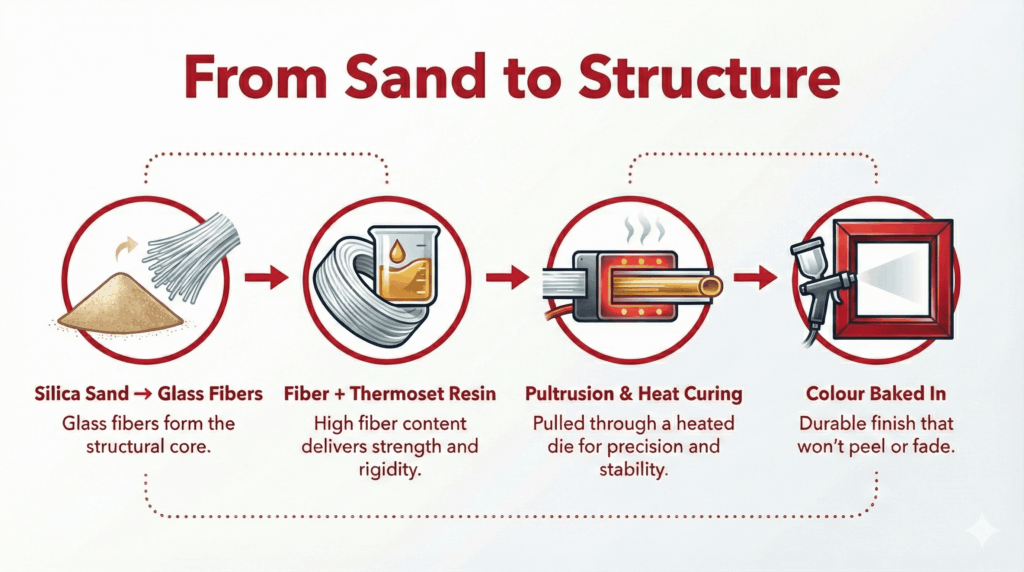
From sand to structure, every step is engineered for strength, stability, and longevity.
Production begins with silica sand, which is melted and drawn into continuous glass fibers. These fibers form the structural backbone of Duxton fiberglass frames.
The glass fibers are combined with a thermoset resin, creating a composite that delivers exceptional strength, rigidity, and resistance to temperature change. This high fiber content is what gives fiberglass its superior performance compared to vinyl or wood.
The fiber-resin mixture is pulled through a heated die, where it is shaped and cured at high temperature. This process ensures consistent wall thickness, precise tolerances, and long-term dimensional stability.
Colour is baked directly into the material, not painted on afterward. The result is a durable, fade-resistant finish that won't peel, blister, or require repainting.
This manufacturing approach is why Duxton fiberglass frames perform reliably in demanding climates and modern architectural designs.